In the process of autonomous driving technology advancing towards higher levels, “precise perception” is the first line of defense to ensure safety. As the “eyes” of autonomous vehicles, LiDAR (Light Detection and Ranging) has become a core component for environmental perception, path planning, and decision-making control, thanks to its advantages of long ranging distance, strong anti-interference capability, and outstanding 3D modeling performance. However, for autonomous vehicles to operate safely in complex road conditions, they need to continuously complete the closed loop of “environmental recognition—distance measurement—risk prediction” in real time. The precise perception of LiDAR is not a “one-time solution”; its performance stability highly depends on regular precise calibration. Off-Axis Reflective Collimators, with their unique technical advantages, have emerged as key equipment to address the pain points of radar calibration and promote the safe implementation of autonomous driving.
In practical applications, LiDAR plays a role across all scenarios of autonomous driving: In high-speed driving scenarios, it needs to detect the distance and speed of vehicles 150 meters ahead to provide data support for adaptive cruise control and emergency braking; in urban road scenarios, it must accurately identify the contours of pedestrians, non-motorized vehicles, and obstacles, and distinguish static facilities such as guardrails and green belts; in parking scenarios, it requires millimeter-level perception of the distance between the vehicle and parking lines or adjacent vehicles to achieve automatic parking. Additionally, LiDAR needs to work collaboratively with cameras, millimeter-wave radar, and other sensors to enhance perception stability under extreme weather conditions (such as rain, fog, and strong light) through data fusion—all of which are based on the accuracy of LiDAR’s own parameters.
However, LiDAR is prone to performance parameter drift during production, installation, and use, resulting in “invisible errors” that affect perception accuracy. Currently, it faces three core pain points:
1. Optical Axis Deviation Caused by Installation and Vibration
LiDAR needs to be fixed on the vehicle roof or bumper. A slight tilt deviation during installation (even just 0.1 degrees) can lead to a ranging error of more than 17 centimeters at 100 meters; bumps and vibrations during vehicle operation will further exacerbate optical axis deviation, causing “false alarms” or “missed detections” in target positioning.
2. Parameter Drift Triggered by Environmental Changes
Temperature changes can cause thermal expansion and contraction of internal optical components in LiDAR, altering the laser emission angle and receiving sensitivity; lens wear and dust accumulation after long-term use will also reduce signal reception quality and affect ranging accuracy.
3. Limitations of Traditional Calibration Methods
Traditional coaxial collimators suffer from central occlusion, generating stray light interference that prevents accurate capture of LiDAR’s far-field performance; moreover, most calibration equipment can only perform static calibration, making it difficult to simulate dynamic working conditions during vehicle operation, resulting in a disconnect between calibration results and actual application scenarios.
To address the shortcomings of traditional calibration technologies, the Off-Axis Reflective Collimator launched by Chongqing Yuling Technology Co., Ltd. (official website: https://chinacqyl.com) has become the core equipment for precise LiDAR calibration, relying on its unique optical structure and technical advantages.
Multiple models are available for customization based on different requirements: FP-500L; FP-1000L; FP-1000L-150; FP-1500L; FP-1500L-200; FP-2000L, etc.
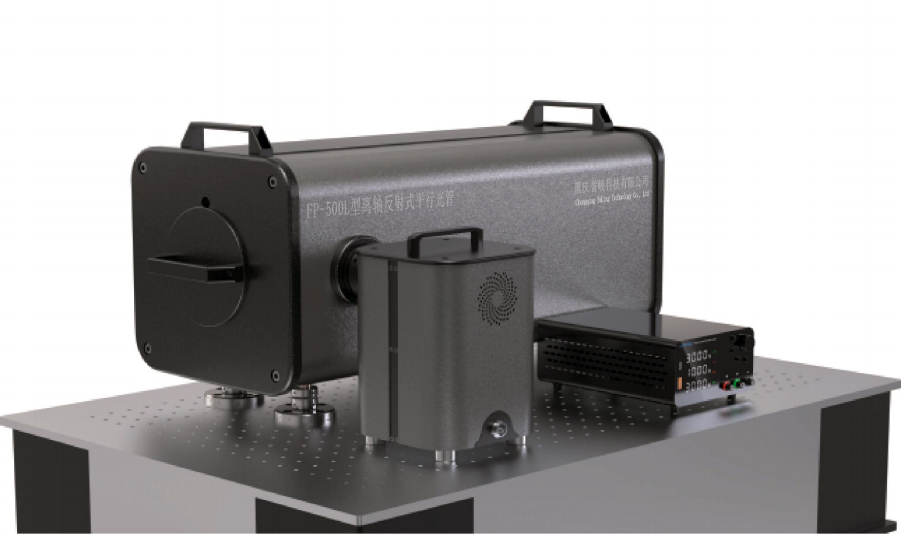
Compared with traditional equipment, the core advantage of the off-axis reflective structure lies in “no central occlusion.” Its core principle is to convert a point light source into unobstructed collimated parallel light beams through off-axis reflectors, simulating optical signals from targets at infinity to accurately measure key parameters of LiDAR such as optical axis deviation and ranging accuracy. By tilting the reflectors to avoid central occlusion, the beam utilization rate is increased to over 95%, enabling precise capture of LiDAR’s far-field spot distribution. This improves the optical axis deviation measurement accuracy to the microradian level (1μrad ≈ 0.000057 degrees), equivalent to controlling the positioning error within 0.57 millimeters at a distance of 1000 meters.
In the calibration process, Off-Axis Reflective Collimators achieve full-scenario coverage of “static calibration + dynamic verification”:
• In the production stage, it can perform factory precision calibration for LiDAR: By adjusting the reticle marks of the collimator, a reference image is formed on the radar’s focal plane to quantify and compensate for the deviation between the laser emission axis and receiving axis.
• In the installation stage, it can simulate target signals at different distances to calibrate the relative position deviation between the radar and the vehicle coordinate system, ensuring the consistency of multi-sensor data fusion.
• More importantly, it can be combined with vibration tables, high-low temperature test chambers, and other equipment to simulate dynamic working conditions such as bumps and temperature changes during vehicle operation, testing the parameter stability of LiDAR under extreme environments to achieve “full-condition calibration.”
Additionally, the equipment features “multi-band compatibility,” which can adapt to LiDAR of different wavelengths. By replacing light source modules, it can simulate multi-spectral signals such as visible light and infrared, meeting the demand for collaborative calibration of LiDAR and other sensors, and further improving the overall accuracy of the autonomous driving perception system.
The safe implementation of autonomous driving is inseparable from “striving for excellence” in every technical link. As the core of perception, the precision calibration of LiDAR is an indispensable key link. Off-Axis Reflective Collimators have become the “precision anchor” to ensure radar performance by addressing the pain points of traditional calibration such as insufficient precision and limited scenario coverage. As autonomous driving technology advances towards L4 and higher levels, the requirements for perception accuracy will further increase, and the technological iteration of Off-Axis Reflective Collimators will continue—future development directions will include realizing automated and intelligent calibration processes through artificial intelligence algorithms, and establishing LiDAR performance attenuation prediction models through big data analysis.