With the rapid development of infrared technology, infrared thermal imagers have become core equipment in fields such as industrial inspection, medical diagnosis, security monitoring, and aerospace. Their core value lies in converting invisible infrared radiation into clear thermal images. Performance parameters including noise, resolution, and field of view directly affect image quality and data validity, while their performance accuracy determines the reliability of data and the accuracy of decisions in practical applications. The Comprehensive Optical Performance Test System for Infrared Thermal Imagers is precisely the key support to ensure the “visual accuracy” of infrared thermal imagers. However, their performance stability is affected by factors such as environment and craftsmanship, making them prone to issues like “parameter drift” and “precision degradation.” Without professional testing methods, thermal imagers may suffer from “missed fault points” or “incorrect temperature judgments,” which can lead to data distortion at best and safety accidents at worst.
In the current application of infrared thermal imagers, the dual pain points of “substandard performance” and “insufficient testing capabilities” have become key obstacles restricting industry development, specifically reflected in two dimensions: technology and scenarios.
A. Technical Pain Points: Traditional Testing Fails to Meet “Full-Dimension, High-Precision” Requirements
1. Incomplete parameter coverage: Most traditional testing equipment can only detect basic parameters such as NETD (Noise Equivalent Temperature Difference) and field of view, lacking the ability to test core performance indicators like MRTD (Minimum Resolvable Temperature Difference) and MDTD (Minimum Detectable Temperature Difference), resulting in missed “hidden performance defects” of thermal imagers.
2. Excessive precision errors: Industrial-grade thermal imagers generally require testing precision within 5mK, but the MRTD and NETD testing precision of traditional equipment is mostly 10-15mK, which cannot meet the high-precision requirements of medical, aerospace, and other fields, easily leading to “temperature misjudgment.”
3. Low degree of automation: Traditional testing relies on manual equipment adjustment and data recording, taking 1-2 days per test. Additionally, manual calculations are prone to introducing errors, making it difficult to adapt to the efficiency needs of mass production or high-frequency inspections.
B. Scenario Pain Points: Difficulty in Adapting to “Personalized Needs” of Different Fields
1. Industrial inspection: In power inspections, thermal imagers need to capture small temperature rises of 0.3℃ caused by loose joints. However, due to insufficient precision, traditional testing cannot verify the equipment’s ability to identify “low-temperature difference signals,” which may trigger accidents such as transformer burnout and line short circuits.
2. Medical health: For thermal imagers used in breast disease screening, excessive non-uniformity (e.g., the testing precision of traditional equipment is only 0.5%) can lead to “uneven brightness” in lesion area displays, increasing the risk of misdiagnosis or missed diagnosis and affecting medical decisions.
3. Aerospace: Thermal imagers mounted on satellites need to work under extreme temperature differences of -50℃ to 80℃. However, traditional testing cannot simulate space environments or verify the equipment’s performance stability under extreme conditions, which may result in invalid remote sensing data.
4. Security monitoring: In forest fire prevention scenarios, thermal imagers need to identify small fire points of 0.5㎡ one kilometer away. However, traditional testing does not cover the “long-distance distortion” parameter, which may lead to missed fire points due to field of view deviations and delay fire disposal.
To address the above pain points, the Comprehensive Optical Performance Test System for Infrared Thermal Imagers independently developed by Chongqing Yuling Technology Co., Ltd. (official website: https://chinacqyl.com) provides a professional solution for performance control of infrared equipment in multiple fields with its comprehensive testing functions and high-precision performance. Through the collaborative design of “hardware + software,” the system builds a complete performance evaluation system:
1. Hardware foundation: The system is equipped with core hardware such as collimators, electric target modules, high-precision differential blackbodies, and multi-dimensional turntables, which can simulate different temperature environments, field angles, and target scenarios, providing real and controllable conditions for testing.
2. Software support: The supporting image analysis software has automated data collection and analysis capabilities, enabling rapid processing of test data and generation of accurate reports to avoid manual calculation errors.
3. Comprehensive parameter coverage: It can conduct tests on 8 core parameters of infrared thermal imagers, including Noise Equivalent Temperature Difference (NETD), Minimum Resolvable Temperature Difference (MRTD), Minimum Detectable Temperature Difference (MDTD), Modulation Transfer Function (MTF), distortion, field of view, non-uniformity, and bad pixels, realizing full-dimensional evaluation from “basic performance” to “detailed performance.”
Different models are available to meet various needs:IBFP-0510LTS; IBFP-1630LTS; IBFP-2030LTS; IBFP-5050LTS
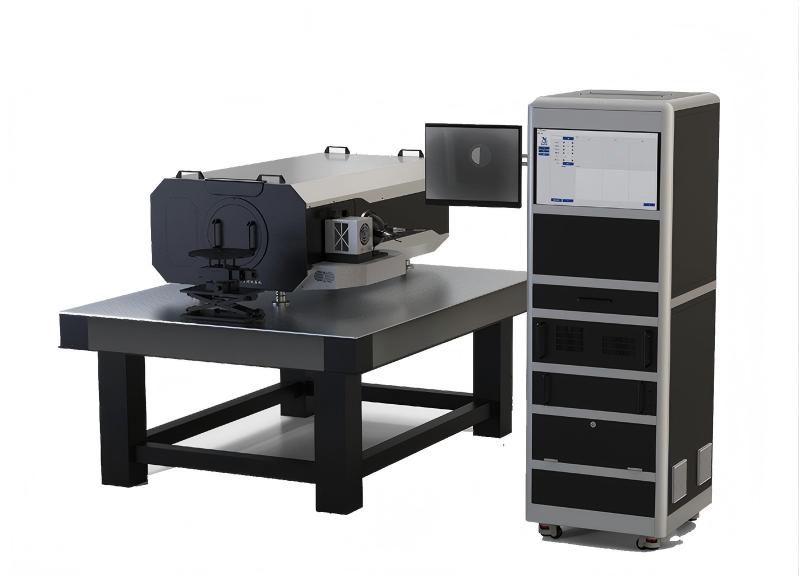
With its comprehensiveness and high precision, the Comprehensive Optical Performance Test System for Infrared Thermal Imagers has been deeply serving multiple key fields, becoming the “behind-the-scenes guarantee” for the practical application of infrared technology.
1. Industrial Inspection Field
In industries such as power, chemical engineering, and rail transit, infrared thermal imagers are the “clairvoyant eyes” for equipment inspection, enabling real-time monitoring of the heating status of transformers, pipelines, motors, and other equipment to predict faults in advance. Through precise testing of parameters such as NETD and MRTD, the test system ensures that thermal imagers can capture small temperature abnormalities of equipment (e.g., 0.5℃ temperature rise caused by loose joints), avoiding missed faults due to insufficient performance and reducing production accidents and economic losses.
2. Medical Health Field
Medical infrared thermal imagers (e.g., those used for breast disease screening and TCM constitution identification) have extremely high requirements for temperature resolution and image uniformity. The MDTD and non-uniformity testing functions of the test system can ensure that thermal imagers can clearly present subtle temperature differences in human tissues, helping doctors accurately identify the location and scope of lesions, avoiding misdiagnosis or missed diagnosis caused by equipment performance deviations, and providing reliable basis for medical decisions.
3. Security and Public Safety Field
In scenarios such as nighttime security, forest fire prevention, and epidemic prevention and control, infrared thermal imagers need to work stably under low light, high temperature differences, complex backgrounds, and other environments. The field of view, distortion, and bad pixel testing functions of the test system can calibrate the observation range and image integrity of thermal imagers, ensuring that they can accurately identify personnel and vehicles at night, precisely locate small fire points in forest fire prevention, and quickly screen people with abnormal body temperatures in epidemic prevention and control, improving the efficiency of public safety prevention and control.
4. Aerospace Field
Infrared thermal imagers in the aerospace field need to withstand extreme environments such as high temperature, vibration, and strong radiation, so performance stability is crucial. The test system simulates the attitude changes of equipment during flight through a multi-dimensional turntable, and combines high-precision differential blackbodies to simulate space temperature difference environments, enabling comprehensive evaluation of the performance of parameters such as NETD and MTF of thermal imagers under extreme conditions, ensuring their continuous and reliable operation in tasks such as satellite remote sensing and aircraft fault monitoring.
In the future, with the expansion of infrared technology applications in emerging fields such as autonomous driving, artificial intelligence, and deep space exploration, the performance requirements for infrared thermal imagers will further increase, driving test systems to develop in the direction of “higher precision, smarter, and more portable,” and providing solid support for the high-quality development of the global infrared industry.