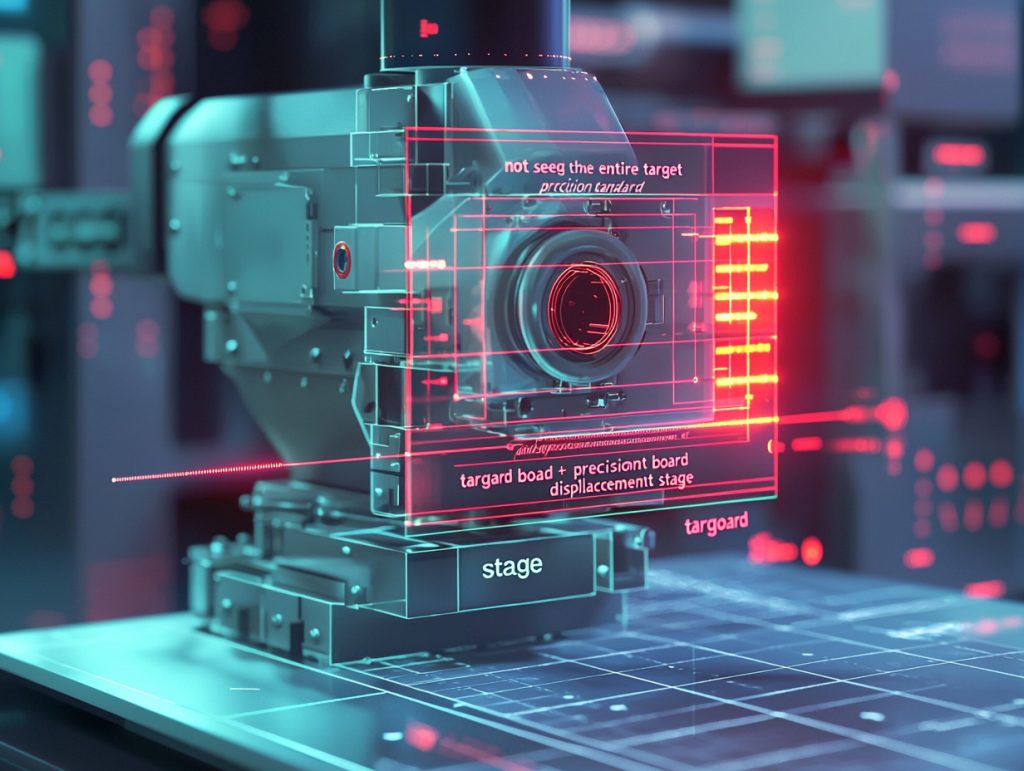
With the accelerated integration of intelligent manufacturing and smart living, laser ranging modules, serving as the “eyes” for devices to perceive the world, have performance that directly determines the operational accuracy of equipment. Laser calibrators, acting as “vision correctors” for these eyes, play an irreplaceable key role in optical axis calibration and lay a solid foundation for the precise perception of devices.
.
.
1.Core Calibration Principles of Laser Calibrators
.
Based on high-precision lasers as reference lines and optical autocollimation and precision sensing technologies, laser calibrators establish an accurate measurement and calibration system. The highly collimated laser beam it emits acts as an invisible standard straight line. When calibrating the optical axis of a laser ranging module, the calibrator obtains accurate calibration data by detecting the offset angle and positional deviation of the transmitting and receiving optical axes relative to the reference laser beam. With built-in precision angle sensors and displacement sensors, it can accurately capture deviations as small as the sub-milliradian level, and analyze and calculate them through a data processing system to provide a reliable basis for subsequent calibration operations.
.
.
2.Calibration Advantages for Different Modules
.
2.1Ideal Calibration Tool for Single-Point Ranging Modules
For single-point ranging modules, laser calibrators effectively solve calibration difficulties with their high precision and flexibility. In high-precision equipment such as electro-optical pods, laser calibrators can perform multi-angle and multi-directional accurate measurements on the optical axes within the compact structure of the module. By adjusting the optical components inside the module, the calibrator can strictly control the parallelism error between the transmitting and receiving optical axes within 0.1 mrad, meeting the equipment’s demand for precise long-distance target ranging in complex environments. Meanwhile, on the premise of ensuring high precision, laser calibrators also balance cost, avoiding the cost increase caused by overly complex calibration equipment and achieving a balance between low cost and high precision.
.
2.2Calibration Guarantee for Scanning Ranging Modules
Facing the challenge of maintaining optical axis consistency during dynamic scanning of scanning ranging modules, laser calibrators demonstrate strong adaptability. In the calibration of scanning ranging modules such as 3D LiDAR used in autonomous driving, the calibrator can simulate dynamic changes during vehicle operation and monitor the optical axis deviation at different scanning angles in real time. Cooperating with scanning components such as MEMS micromirrors, it performs dynamic calibration during module operation, ensuring that the optical axis remains highly consistent under complex working conditions such as mechanical vibration and temperature changes, guaranteeing the accuracy and stability of 3D point cloud imaging, and providing reliable environmental perception data for autonomous driving systems.
.
.
3.Market Prospects and Application Expansion of Laser Calibrators
.
3.1Application Expansion in Intelligent Manufacturing
In intelligent manufacturing, laser calibrators will become core tools for automated production lines and equipment monitoring. With the intelligent transformation of the manufacturing industry, laser calibration technology will be widely used in the calibration and inspection of equipment such as robots and CNC machine tools, ensuring production accuracy and efficiency while reducing production costs.
.
3.2Precision Measurement in Medical Equipment
In the field of medical equipment, high-precision laser ranging modules are widely used in scenarios such as surgical navigation and image guidance. The application of laser calibrators will further improve the measurement accuracy of medical equipment, provide more reliable support for surgical operations, and ensure patient safety.
.
3.3Intelligent Transportation and Urban Planning
With the development of urban intelligent transportation systems, the importance of laser ranging modules has become increasingly prominent. Laser calibrators will play an important role in applications such as traffic monitoring and vehicle autonomous driving. Precise calibration technology ensures the measurement accuracy of traffic equipment and provides data support for urban planning and traffic management.
.
3.4Applications in Scientific Research and Experiments
In the field of scientific research and experiments, laser calibrators can provide key support for detailed experiments. Whether in physical experiments, material research, or aerospace fields, the application of laser calibration technology will improve experimental accuracy and promote the in-depth development of scientific research.